
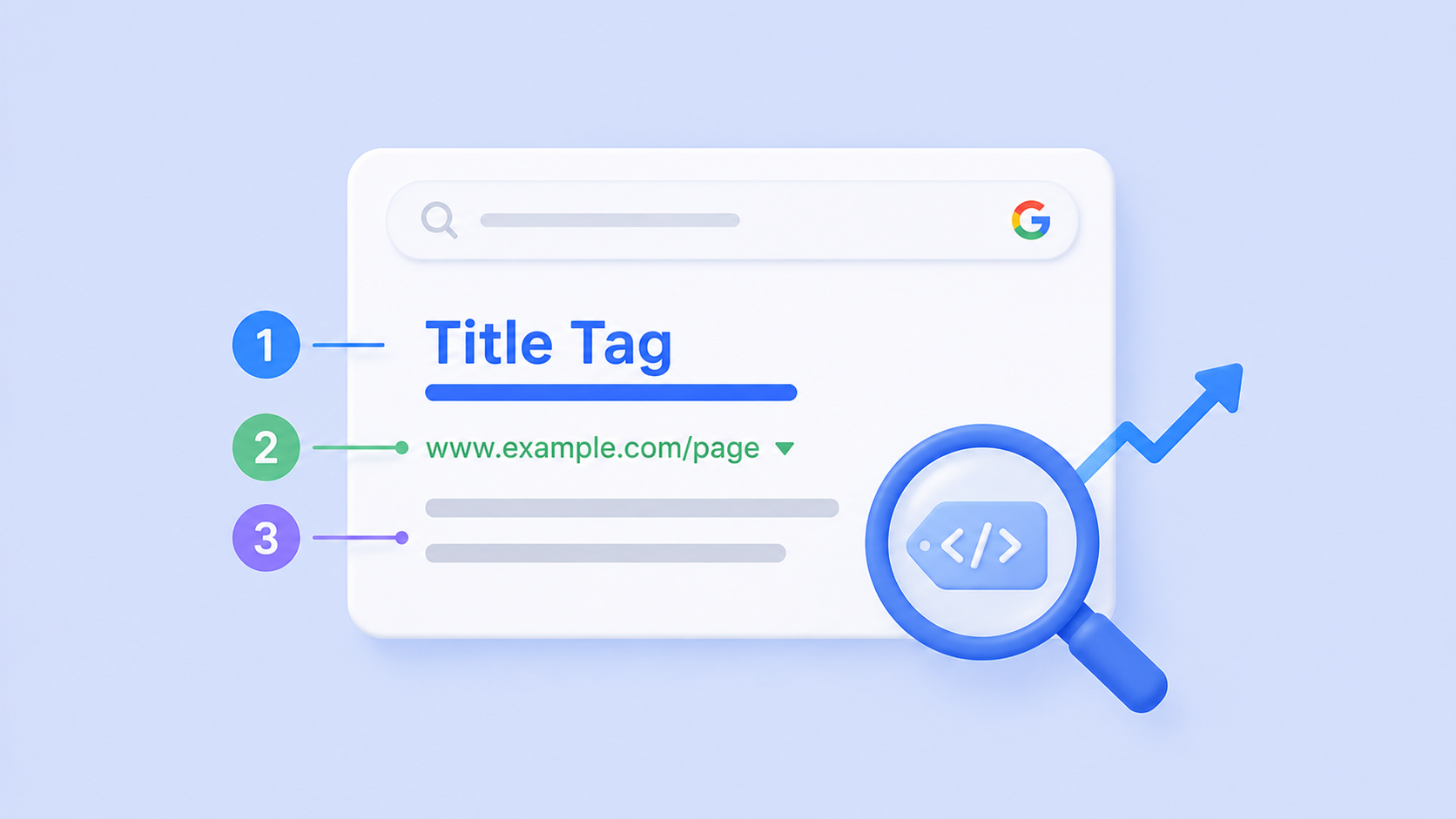
When someone sees your page in search results, what do they notice first?
In most cases, it’s the title.
Before users read the description, before they visit your website, and often before they even look at the URL, they read the headline displayed in the search results.
That headline is your title tag.
Among all on-page SEO elements, the title tag remains one of the most important. It helps search engines understand what a page is about and helps users decide whether your page is worth clicking.
Many SEO professionals view the title tag as the first advertisement for a page.
You can have excellent content, but if the title fails to attract attention, many users will never see it.
Quick Summary
| Topic | Explanation |
|---|---|
| Title Tag | The title displayed in search results |
| Main Purpose | Communicate page topic to search engines and users |
| SEO Impact | Very high |
| CTR Impact | Very high |
| Recommended Length | Around 50–60 characters |
| Core Principle | Match search intent and clearly communicate value |
What Is a Title Tag?
A title tag is the text placed inside the HTML
Search engines use this title to understand the topic of a page and often display it as the clickable headline in search results.
A typical search result consists of three key elements:
| Element | Purpose |
|---|---|
| Title | The clickable headline |
| URL | The page address |
| Meta Description | The supporting summary |
Of these three elements, the title usually receives the most attention.
For example, imagine someone searches for:
“how to write a meta description”
The first thing they will likely scan is the page title.
In many cases, the title alone determines whether a user clicks or scrolls past.
Why Are Title Tags Important?
Title tags influence both SEO performance and click-through rates.
Search engines use titles as a strong signal to understand page relevance.
Users use titles to decide whether a page appears useful enough to visit.
This makes title tags one of the few SEO elements that directly affect both search engines and human behavior.
Consider these two examples.
Generic Title
SEO Guide
More Specific Title
What Is SEO? A Beginner’s Guide to Search Engine Optimization
The second title immediately communicates:
- What the page is about
- Who it’s for
- What the reader will learn
As a result, it is more likely to attract clicks.
What Makes a Good Title Tag?
Strong title tags tend to share a few common characteristics.
First, they align with search intent.
The title should reflect what users are actually trying to learn or accomplish.
Second, they clearly communicate the topic.
Someone should be able to understand the purpose of the page simply by reading the title.
Third, they remain concise.
Overly long titles may be truncated in search results, reducing their effectiveness.
In short, a great title tag helps search engines understand the page while encouraging users to click.
Title Tag Best Practices
1. Place Important Keywords Near the Beginning
Both users and search engines pay more attention to the beginning of a title.
For that reason, your primary keyword should appear as early as possible.
For example:
What Is a Title Tag? A Complete Guide to SEO Title Tag Optimization
The main topic appears immediately.
Compare that to:
Essential SEO Techniques and Strategies for Better Search Performance Including Title Tag Optimization
The primary topic becomes less obvious because it appears later in the title.
2. Match Search Intent
People don’t search for keywords.
They search to solve problems.
Consider the following searches:
| Search Query | User Intent |
|---|---|
| What is a title tag | Learn the concept |
| How to write title tags | Practical implementation |
| SEO title tag examples | See examples |
| Title tag length | Find recommended guidelines |
Although all these searches relate to title tags, they represent different needs.
The best titles acknowledge those needs directly.
3. Give Users a Reason to Click
A title tag is not just an SEO element.
It’s also a marketing message.
Users should immediately understand why your page is worth their time.
Standard Title
How to Write Title Tags
More Compelling Title
How to Write Title Tags That Improve SEO and Increase Click-Through Rates
The second version highlights a clear benefit, making it more attractive to searchers.
How Long Should a Title Tag Be?
There is no official character limit.
However, most SEO professionals recommend keeping titles around 50 to 60 characters.
Short titles may fail to communicate enough value.
Long titles may get cut off in search results.
Whenever possible, place your most important keywords and messaging near the beginning.
| Length | Typical Outcome |
|---|---|
| Under 30 characters | May lack context |
| 50–60 characters | Generally recommended |
| Over 70 characters | Higher chance of truncation |
Why Does Google Rewrite Title Tags?
One of the most common SEO questions is:
“Why is Google showing a different title than the one I wrote?”
The answer is simple.
Google does not always use your title tag exactly as written.
If Google’s systems believe another title would better represent the page or match the user’s search query, they may generate an alternative title.
This is more likely to happen when:
- The title is too long
- The title is too short
- The title is vague
- Multiple pages use the same title
- Keywords are repeated excessively
- The title doesn’t accurately reflect the page content
The best way to reduce title rewrites is to create clear, descriptive, and user-focused titles from the start.
Title Tag Examples
SEO Fundamentals
What Is SEO? A Beginner’s Guide to Search Engine Optimization
AEO Article
What Is AEO? Answer Engine Optimization Explained
GEO Article
What Is GEO? A Complete Guide to Generative Engine Optimization
Meta Description Guide
How to Write Meta Descriptions: SEO Best Practices and Examples
SaaS Landing Page
Monitor and Manage Backlinks with Lantler
Frequently Asked Questions
Are title tags important for SEO?
Yes.
Title tags are one of the strongest on-page signals search engines use to understand page content and relevance.
Is a title tag the same as an H1?
No.
A title tag is typically displayed in search results and browser tabs, while an H1 is the primary heading shown on the page itself.
Should title tags contain keywords?
Generally, yes.
Including relevant keywords helps search engines understand the topic, but keyword stuffing should always be avoided.
What is the ideal title tag length?
Most SEO professionals aim for approximately 50–60 characters, although there is no strict requirement.
Can multiple pages use the same title tag?
It’s not recommended.
Every page should have a unique title that reflects its specific content and search intent.
Can I prevent Google from rewriting my title?
Not completely.
However, well-written, descriptive titles are less likely to be modified.
Conclusion
Title tags remain one of the most powerful elements in SEO.
A strong title helps search engines understand your content while giving users a compelling reason to click.
Fortunately, writing effective title tags doesn’t have to be complicated.
Focus on four principles:
- Match search intent
- Include important keywords
- Communicate clear value
- Keep titles concise and readable
Before publishing a page, ask yourself two questions:
Can someone understand what this page offers just by reading the title?
And:
Would this title stand out among competing search results?
If the answer to both questions is yes, you’re likely on the right track.
Because in SEO, visibility matters.
But clicks matter just as much.